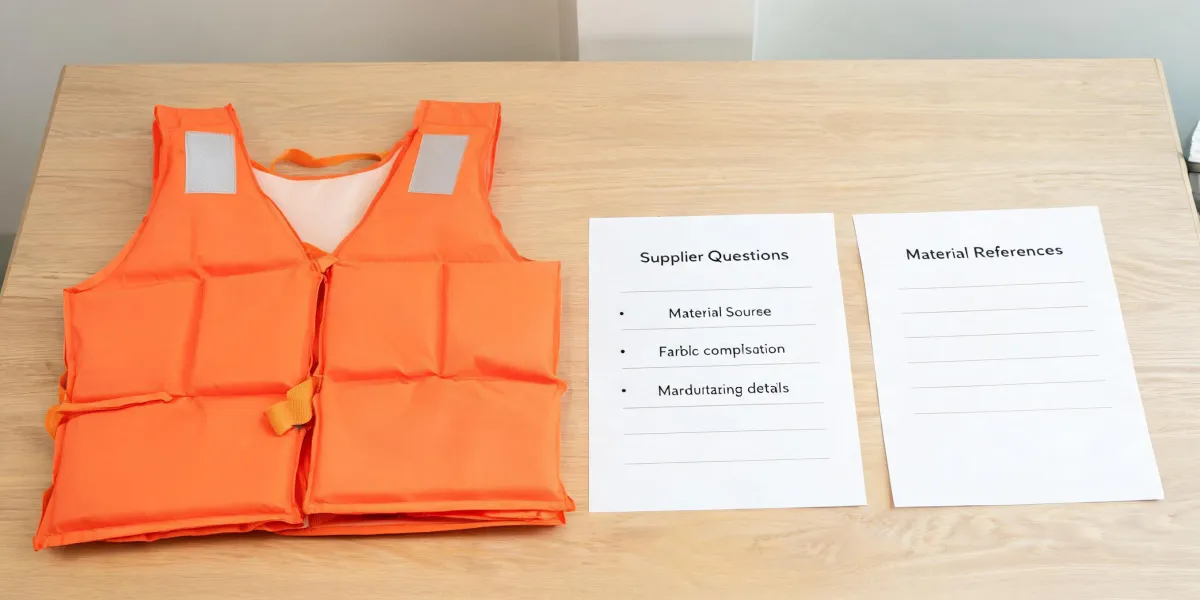
The receiving team opens the first carton from a custom life jacket run, checks color, stitching, and label against the approved sample, and signs the lot off. That is a cosmetic check, not an acceptance decision. A sample-matched custom life jacket can still be damaged in ways that do not show on the outside, or fitted with an inflator that is not serviceable. Incoming inspection has to turn on serviceability evidence, not appearance.
So the question at the dock is not whether the lot matches the sample. It is what evidence proves the lot is serviceable, and whether that evidence lives in the supplier's records or only in someone's memory of the sample.
The Check That Passes a Bad Life Jacket
Suppose a receiving team opens a carton from a first custom production run. The color is close, the stitching is even, the label carries the right artwork, and the lot goes into stock. Every item on that list covers appearance. None of it covers the condition that decides whether an inflatable can be counted on at all: the source ties serviceability to cylinder and indicator status, not to a clean look.
Damage runs the same way. Waterlogged, faded, or otherwise damaged devices should be discarded. A carton can hold units that are damaged in ways nobody grades by eye at the dock. The carton looks right, the sample match is real, and the receipt is still wrong. That's the trap, and it is easy to miss.
Why does the cosmetic check survive in so many receiving areas? Because it is cheap, fast, and produces a signature. It answers the question the buyer asked at sampling time, which is whether this looks like what was approved. It never touches the question that decides acceptance.
Serviceability Is a Gate, Not a Cosmetic Grade
What does serviceability mean for a lot sitting on your dock? Narrowly, it is the state in which a specific unit can serve its intended flotation or carriage role under the stated conditions. It is not the state of looking undamaged.
That definition has parts, and each part is checked differently. For an inflatable, serviceability depends on cylinder and indicator condition. For a foam-filled device, correct wear means a snug fit that does not let the jacket rise above the wearer's chin or ears. For condition, a unit that is damaged at all is a discard decision, not a cosmetic score. Three different questions, three different pieces of proof.
A cosmetic grade collapses all three into a single glance. That is why a clean jacket can still be a lot that fails.
Damage, Serviceability, and Carriage Are Different
If a unit is damaged, is it automatically not serviceable? The two labels sit close together, they are not the same, and neither one is the same as failing the carriage requirement.
Take them one at a time. Damage is a condition call on the unit itself. A unit can also fail serviceability while looking intact, and a non-serviceable unit does not satisfy the carriage requirement. So a device can be physically present and cosmetically clean and still fail the requirement, while a damaged device is a discard whether or not anyone ever inflated it.
The consequence for a receiving record is that it needs separate dispositions: discard, held for supplier evidence, accepted. One pass-or-fail column cannot hold three outcomes, and forcing it to will bury the unit that matters most.
What the Inflator Status Changes on the Dock
An inflatable can pass every visual check on the floor and still be blocked. What blocks it? The cylinder and the indicators.
Inflatable life jackets and buoyancy aids must have a full cylinder and all status indicators on the inflator must be green, or the device is not serviceable and does not satisfy the requirement to carry lifejackets. That is an acceptance condition stated flatly, and it applies before anything else about the order gets discussed.
What that condition does not give you is a sampling plan or a method for reading those indicators in your own warehouse. Those come from the approved specification and from what the supplier's quality documentation commits to. For a custom lot, the RFQ should ask how the supplier records cylinder fullness and indicator status before shipment, and what the record looks like when a unit fails. A buyer who invents a pass rule from a web page is building an inspection that will not survive a serious question.
Why Fit Has to Be Shown, Not Assumed
For a foam custom life jacket, why is fit a serviceability question rather than a line on a size chart? Because the outcome is what counts. When worn correctly, a foam filled life jacket or buoyancy aid fits snugly and does not rise above the wearer's chin or ears. That is behavior under wear, not a number on a spec sheet.
A size chart can tell you what the pattern was meant to produce. It cannot tell you that this lot, with this foam batch and this shell cut, produces that fit on the wearer set you are buying for. The fit-check method, the wearer sizes, and the tolerances are not in public guidance; they belong to the approved design and to the supplier's documented procedure.
Ask for that approved method and the sample approval evidence behind it. A tape measure on the dock, handled by whoever is free that morning, produces a number. It does not produce proof of fit.
Where Incoming Inspection Must Stop
When does a dock finding become a question the dock cannot settle? The moment the answer would change the product rather than the disposition of one carton.
Incoming inspection does not authorize changes to an approved PFD's structure, buoyancy material, or markings. A proposed change is an approval or design-change question, not a dock decision, and it cannot be settled on a receiving report. Inspection also does not stand in for sample testing, a factory audit, or supplier batch inspection. If those have not been run, a clean receiving check has not covered the same ground.
The same boundary applies to missing information. Supplier capability, MOQ, lead time, tooling, certification, and the exact approved configuration stay RFQ questions until the documents arrive. Writing a comfortable specification from assumption is guessing on a device people wear in the water.
This is not for a buyer who wants a visual pass or fail and no supplier paperwork. It is for sourcing and QC teams that will hold acceptance until damage status, fit, inflator serviceability, and approval scope are documented.

Leave a comment