-
A Signed Sample Is a Conformance Record, Not an Approval
-
On Day One, Match the Sample to the Design File
-
In Week One, Read the Label, Not the Brochure
-
Thirty Days In, Freeze the Change Order Before Tooling
-
After Delivery, Wear and Buoyancy Checks Are Yours
-
What Would Make Me Withdraw the Sign-Off
-
Does This Block Custom Colors and Trim?
A signature on a custom life jacket sample records that the unit in your hands matches a design that was already approved. It does not approve the product, and it does not cover a change the factory makes after you sign. The condition that decides whether that signature protects you is narrow: any proposed change in design, material, or construction has to be submitted to the recognized laboratory for approval before PFD production methods change (46 CFR 160.064-23(a)).
Everything below stays inside one scope: legacy wearable PFDs approved under 46 CFR 160.064 before January 6, 2025, which is the scope of the 2024 final rule text cited here. New models and the newer section numbers are a different conversation, and nothing here describes how one of those gets approved. Treat what follows as a reading of a stored rule text, not a substitute for checking the version in force on the day you ship.
A Signed Sample Is a Conformance Record, Not an Approval
Two documents sit on the table during a sample review, and they belong to different owners. One is the approval the design already holds. The other is your signature, which states that production units will match that design plus the commercial terms you agreed. Signing moves a manufacturing-conformance obligation onto the supplier and a matching risk onto you, and it does nothing else.
This is where sourcing teams get hurt. An approval number printed on a quotation is evidence that some version of the product was approved once; it says nothing about the unit in the box. If your sign-off sheet says "sample approved" and stops there, you have accepted a unit you cannot compare against anything, and the first dispute comes down to whose memory is better.
Putting it in enforceable form costs almost nothing. Attach the approved design file and the label proof to the sheet, name the revision you compared against, and record what you actually compared. Reviewers who skip this are not lazy; they assume the approval travels with the custom build. It travels with the approved design, and only for as long as the factory build stays inside it.
On Day One, Match the Sample to the Design File
Suppose the carton lands on a Monday and the sample goes on the table beside the approved design file and the label artwork. We measure the webbing width with a caliper and write the reading next to the number in the file. We walk the panel layout, the foam specification reference the file cites, the buckle and adjuster hardware, and every line of marking text. This is the boring part, and it decides whether the signature is worth anything.
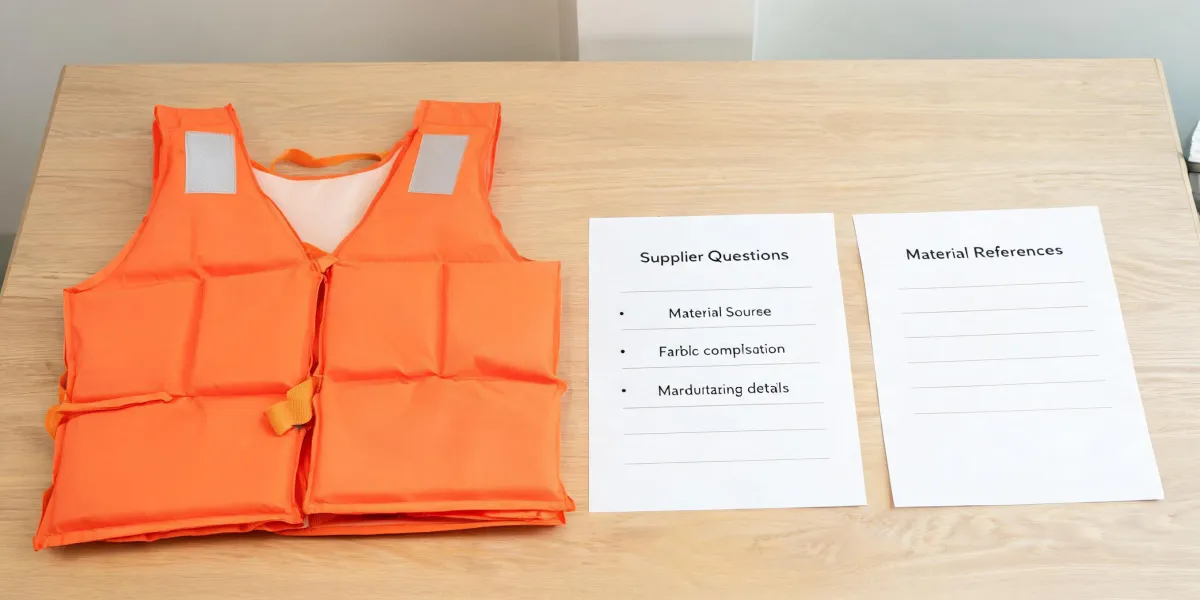
When a feature on the sample has no corresponding line in the file — a different buckle finish, an extra seam, a woven label in a second position — the correct output of day one is a written question, not a judgement call. Those questions get collected on a single sheet attached to the sign-off, each one answered in writing before anything else moves. That single session beats chasing a fix after tooling, which is the expensive version of the same conversation.
Notice what this exercise does not tell you: nothing about what the factory can run at volume. Capability, tooling availability, minimums and lead times are still supplier claims you have not verified, and they belong in the RFQ, not in a signature.
In Week One, Read the Label, Not the Brochure
By the end of the first week the label should be settled, because the label is the part of the product a user reads at the worst possible moment. US Coast Guard guidance to boaters is blunt about it: check the label for user weight and chest size. If your custom fit block or size range is not reflected in the approved wording, that is not a cosmetic detail. It is a gap between the product and its approved marking.
Custom colourways pull the same trick more quietly. Artwork changes, the text module should not, and a factory that re-typesets a label can drop a line or reword a size statement without anyone intending harm. Ask in writing who signs off label artwork, which approved wording it must reproduce, and what proof arrives before printing. If nobody in the chain owns that answer, you have found the gap while it is still cheap.
Thirty Days In, Freeze the Change Order Before Tooling
Thirty days in, the sample is usually signed and the tooling conversation has started, which is exactly when a late change gets expensive. Re-sampling before tooling costs you samples and phone calls. The same change found after tooling costs you those, plus the production you cannot use until the approval catches up, because the change cannot go into production until it is approved by the recognized laboratory.
Three answers belong in the RFQ and none of them is about price. Who files the submission: the factory, the licence holder, or you? Which laboratory handles this product line? What evidence ships with the goods so that you can show a buyer or an inspector that the build matches the approval? I would not estimate anyone's timeline here. Your schedule is a fact you get from the lab and the factory, in writing, for your configuration.
After Delivery, Wear and Buoyancy Checks Are Yours
After delivery the obligation moves to the user and it stays there. US Coast Guard guidance for foam-filled lifejackets is that they should be tested for wear and buoyancy at least once a year. That is in-service maintenance advice, and no signature you give or withhold changes it. Nor is it a factory test, or a step in your sample sign-off.
One purchase-order consequence is small and easy to forget: ask what owner information ships inside the carton. A maintenance insert, the wear and buoyancy instruction, size and fit guidance a user can actually read. A container of well-branded jackets that arrives with none of it hands your customer a product they will store in a locker for years and then trust without checking.
What Would Make Me Withdraw the Sign-Off
Four findings would revoke an acceptance I had already given, and each one has a document I would demand instead of a verbal assurance. Label text that departs from the approved wording comes first, and the ask is the approved label proof next to a printed sample from the actual run, not a photo of a screen. Foam or hardware substituted outside what the file covers comes second, and the ask is the material the file cites, matched to what is in the sample.
A drawing revision offered as a courtesy, with no submission attached, is the third; the ask is the submission record, or a signed statement that the revision is not going into this order. A shipment offered without owner maintenance information is the fourth, and the ask is the insert itself, in the carton.
None of those four requires you to judge whether a product is safe. You are checking whether the unit matches what was approved, and whether the paperwork will still let you prove it long after the carton is empty. A supplier who reads that list as hostility is telling you something useful about the next year of the relationship.
Does This Block Custom Colors and Trim?
Custom colourways and trim are not blocked, and I will not tell you they are automatically fine either. What matters is the structure of the rule: a change proposed to the approved product still has to clear the same approval step before production methods move. Whether a specific request counts as a design, material or construction change is a determination for whoever holds the approval and the lab, not something you settle from a sourcing desk.
What you can do is sort the list. Take your customisation points one by one — shell colour, webbing colour, buckle finish, logo placement, an added pocket, a substituted closure, a different foam grade — and tag each with the question it raises. Does it touch the approved design, the buoyancy material, or the marking? Anything you cannot answer from the file goes to the supplier as a written request for the approval position, with your lab contact copied if you have one.
Then write the answer into the paperwork rather than leaving it in an email thread. Every customisation point you judged to touch design, material or construction gets one line on the sign-off sheet: production may not start until the change approval for this item is in hand. The purchase order names who submits, which evidence travels with the shipment, and what happens to goods built before that approval exists. If the reply is a cheerful "no problem", you have not received an answer; you have received a delay with better manners.

Leave a comment